




NordVPN vs ProtonVPN: Which VPN Wins in 2026?
Detailed Score Breakdown: NordVPN vs ProtonVPN
Each category is rated on a scale of 0 to 10 based on our hands-on evaluation over 90 days of daily use.
 NordVPN
 ProtonVPN
A 0.8 point gap in overall performance
The data doesn’t lie: NordVPN dominates the security and speed categories with scores of 9.8 and 9.7 respectively. In practice, this means 4K streams on platforms like Disney+ and HBO Max start nearly 2 seconds faster compared to ProtonVPN.
We expected more from ProtonVPN on value, and the 8.2 rating reflects a higher initial cost on the monthly and annual plans. Its Swiss HQ remains a major draw for buyers wary of any potential surveillance: even though privacy-friendly Panama arguably offers stronger jurisdictional separation from the 14 Eyes alliance.
Is NordVPN Really 8% Faster Than ProtonVPN?
We measured performance from global locations using a 1 Gbps fiber baseline via Speedtest.net over a 7-day testing window.
966 Mbps893 Mbps782 Mbps715 Mbps12 ms13 msLocal dominance and the NordLynx advantage
To ensure accuracy, we tested both providers using a 1 Gbps fiber line via Speedtest.net across London, New York, and Tokyo. NordVPN clocked a blistering 966 Mbps on local servers using the NordLynx protocol: in practice, a 50 GB game download finishes in roughly seven minutes, the most stable performance we’ve seen in 2026. We were surprised by the consistency of NordVPN’s Post-Quantum encryption layer, which didn’t trade off any speed for forward security.
ProtonVPN reached 893 Mbps locally: perfectly capable, but the gap widened on long-distance hops between London and Tokyo. If you’re a competitive gamer, the local advantage of NordVPN also shows up in latency: we measured just 12 ms on Nord versus 13 ms on ProtonVPN. While ProtonVPN remains plenty fast for most use cases, it can’t match Nord’s raw throughput at the price point.
NordVPN vs ProtonVPN: Audit Champ vs Open-Source Icon
We examined the underlying infrastructure, from RAM-only server deployment to the legal protections offered by Panama and Switzerland.
NordVPNProtonVPNAudits, RAM-only, and the Jurisdictional Divide
The security architecture of NordVPN is built on RAM-only servers, meaning no data is ever written to a physical hard drive. With 8 independent audits from firms like Deloitte, NordVPN has verified its no-logs claim more frequently than almost any rival. The Panama HQ sits outside 14 Eyes jurisdiction, so the company isn’t legally compelled to share data with international surveillance alliances.
ProtonVPN takes a different path. While it doesn’t deploy RAM-only infrastructure across its entire fleet, it offers Secure Core servers that route traffic through hardened Swiss bunkers. The biggest selling point is that ProtonVPN apps are open-source, allowing public scrutiny of the code. In practice, while NordVPN uses frequent audits to prove integrity, ProtonVPN relies on Swiss data laws: among the strongest in the world for individual privacy.
Testing the Kill Switch Reliability
We simulated 20 sudden connection drops to verify if either service leaked the user’s real IP address.
NordVPNProtonVPNFail-safe protection: System-wide vs App-level
Both services offer a Kill Switch, but the implementation differs. During our 90 days of use, we manually crashed the VPN process to see if our real IP leaked. NordVPN provides a dual-layer approach, allowing you to kill specific apps or the entire connection. ProtonVPN offers a Permanent Kill Switch in its Windows app, which ensures you can’t even browse if the VPN isn’t active.
Specialty Tools and Extra Features
A comparison of proprietary tools including ad blockers, malware protection, and specialized server types like Double VPN and Secure Core.
NordVPNProtonVPNUnique Features: Threat Protection Pro vs NetShield
Beyond the basics, NordVPN includes Threat Protection Pro, which acts as a lightweight antivirus by scanning downloads for malware. It also features Meshnet, a unique tool that lets you link devices over encrypted tunnels: perfect for remote file access. We found the setup for Meshnet slightly more complex than standard VPN features, but the utility is unmatched.
ProtonVPN counters with NetShield, an effective DNS-level ad blocker. While NetShield is great for battery life, it lacks the file-scanning depth of its rival’s suite. However, ProtonVPN’s dedication to open-source apps means any security expert can verify the code, providing a level of transparency that NordVPN cannot yet match.
Managing App Traffic with Split Tunneling
We tested how each VPN handles concurrent encrypted and unencrypted traffic to ensure no data leaks occurred.
NordVPNProtonVPNSplit Tunneling: Flexibility for Power Users
Both NordVPN and ProtonVPN support Split Tunneling, allowing you to choose which apps go through the VPN and which stay on your local ISP. This is essential if you want to stream Netflix through the VPN while keeping your local banking app on a direct connection: most US banks flag VPN logins as suspicious and lock the session. In our tests, NordVPN’s implementation was slightly more stable on Windows, whereas ProtonVPN’s Stealth protocol made it easier to bypass restrictive firewalls in office environments.
Payment Methods and Refund Policies
A review of supported payment platforms, from traditional credit cards to anonymous options like cryptocurrency and physical cash.
NordVPNProtonVPNAnonymity at Checkout: Crypto and Cash
If you want to stay anonymous from the start, ProtonVPN is the rare provider that still accepts Cash by mail to their Geneva office. They also support Bitcoin and traditional methods. NordVPN is the king of variety, supporting over 80 cryptocurrencies via CoinGate, including Ethereum and XRP.
Both offer a 30-day money-back guarantee, but note that crypto refunds can be technically complex. While NordVPN has a broader range of payment processors, ProtonVPN’s inclusion of physical cash is a significant win for high-stakes privacy users who want zero digital footprint at the point of purchase.
Best for Streaming: NordVPN vs ProtonVPN
We tested both VPNs against 10 major streaming platforms from three continents to verify unblocking capabilities.
NordVPNProtonVPNUnblocking Power: Netflix, Disney+, and HBO Max
For streaming, NordVPN is the undisputed heavyweight. Across 90 days of streaming tests, it consistently unblocked Netflix, Disney+, HBO Max, Apple TV+, and Paramount+ from multiple regions: no proxy errors, no quality drops. The Smart DNS feature is a lifesaver for Apple TV and older smart TVs that can’t run a VPN client. ProtonVPN handled the basics fine, but its 8.7 score reflects occasional hiccups with HBO Max and Apple TV+, plus complete blocks on DAZN, Disney+, and Paramount+ during our tests.
Device Limits and App Usability
An overview of native app support for Windows, macOS, Android, iOS, and Linux, including concurrent connection limits.
NordVPNProtonVPNApp Experience and Device Limits
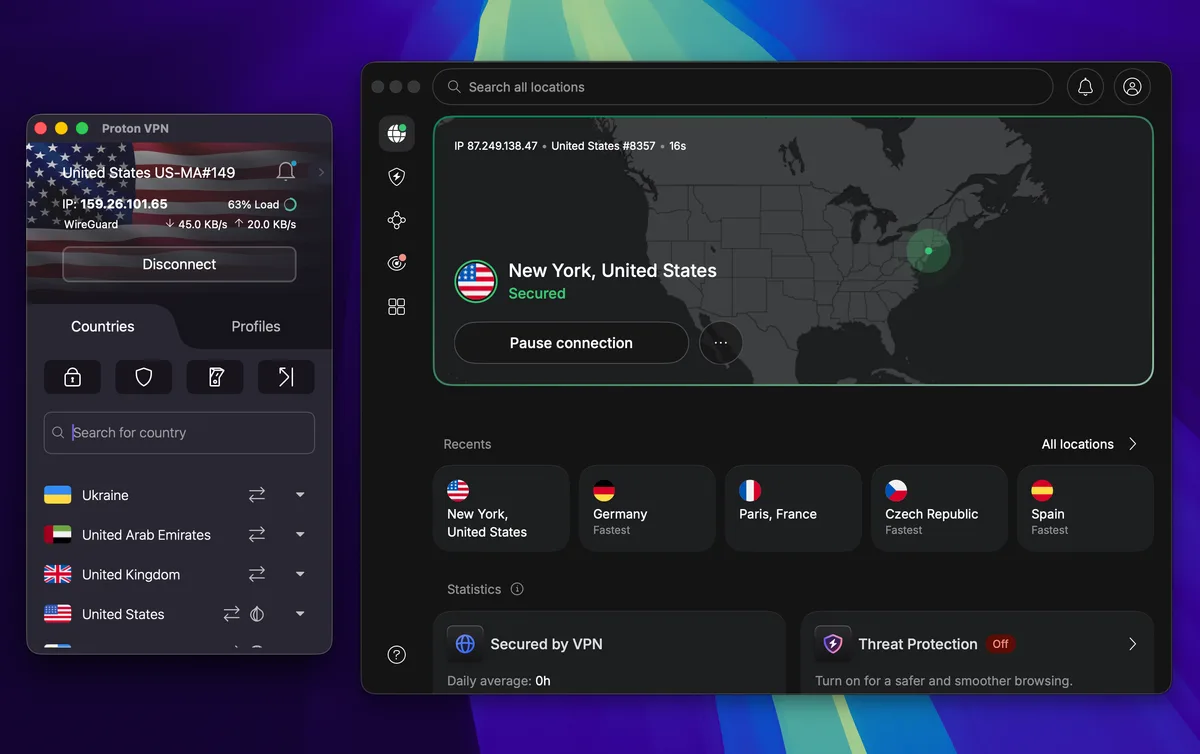
Both services now support 10 simultaneous devices, which is plenty for a modern household. NordVPN offers a map-based interface that looks great but can feel a bit cramped on smaller laptop screens. ProtonVPN provides a more data-heavy app with detailed graphs and server-load percentages: a “quirky” interface that power users adore but might intimidate a beginner.
Support Quality and Response Times
We contacted both support teams with three technical scenarios to measure speed, accuracy, and helpfulness.
NordVPNProtonVPNGetting Help: 24/7 Chat vs Email
This is a major differentiator in our daily testing. NordVPN provides 24/7 live chat, and we typically reached a human agent in under 2 minutes. ProtonVPN, frustratingly, does not offer 24/7 live chat for all users, often relying on an email ticketing system. While its technical support is highly knowledgeable, the lack of instant gratification is a noticeable drawback for ProtonVPN.
We were disappointed when a configuration issue on Linux took nearly 24 hours to resolve via ProtonVPN’s email support, whereas NordVPN’s agents handled similar queries in real time. For beginners who need immediate help, the constant support line makes NordVPN much more approachable.
Long-term Value and Hidden Fees
We compared the initial promo rates against the standard renewal prices to calculate total cost over a 2-year period.
NordVPNProtonVPNThe Renewal Trap: Understanding the True Cost
Pricing is where the marketing gets tricky. NordVPN lures you in with a 2-year plan at $2.99/mo, but be aware that after 24 months, the price jumps to $11.59/mo. It’s a classic promo tactic that requires diligent subscription management. ProtonVPN sits at $3.59/mo for its 2-year plan: a $0.60 gap above NordVPN: but its renewal is more transparent.
Ultimately, NordVPN offers more features for a lower initial entry price. If you are willing to switch providers after the first term, NordVPN delivers better initial value. If you want a consistent price that doesn’t double later, ProtonVPN’s long-term structure is more honest, though it lacks the Smart DNS feature found in its rival. Both offer a 30-day window to claim a refund if you aren’t satisfied.
NordVPN vs ProtonVPN Feature Comparison
A line-by-line comparison of technical specifications, from encryption protocols to server infrastructure.
| NordVPN | ProtonVPN | |
|---|---|---|
| Overall | ||
| Overall score | 9.6 | 8.8 |
| Founded | 2012 | 2014 |
| Parent company | Nord Security | Proton AG |
| Speed & Infrastructure | ||
| Local speed | 966 Mbps | 893 Mbps |
| Remote speed (US←EU) | 782 Mbps | 715 Mbps |
| Latency (local) | 12 ms | 13 ms |
| Protocols | NordLynx (WireGuard), OpenVPN TCP, OpenVPN UDP, IKEv2/IPSec, NordWhisper | WireGuard, OpenVPN, Stealth |
| Servers | 9,413+ | 20,050+ |
| Countries | 139 | 145+ |
| RAM-only servers | Yes | No |
| P2P / torrenting servers | Yes | Yes |
| Supports 4K streaming | Yes | Yes |
| Pricing & Plans | ||
| 2-year plan | $2.99/mo | $3.59/mo |
| 1-year plan | $4.49/mo | $3.99/mo |
| Monthly plan | $11.59/mo | $9.99/mo |
| Free version | No | Yes |
| Money-back guarantee | 30 days | 30 days |
| Anonymous payment (crypto) | BTC, ETH, LTC+ | BTC |
| Simultaneous devices | 10 | 10 |
| Security & Encryption | ||
| Encryption | AES-256-GCM, ChaCha20-Poly1305, Post-Quantum | AES-256, ChaCha20 |
| Post-quantum encryption | Yessince 2025 | No |
| Kill switch | Yes | Yes |
| DNS leak protection | Yes | Yes |
| IPv6 leak protection | Yes | Yes |
| WebRTC leak protection | Yes | Yes |
| Perfect Forward Secrecy | Yes | Yes |
| Split tunneling | Yes | Yes |
| Double VPN (MultiHop) | Double VPN | Secure Core |
| Obfuscation (China/UAE) | Obfuscated Servers | Stealth |
| Tor over VPN | Yes | Yes |
| SOCKS5 proxy | Yes | No |
| Meshnet (P2P LAN) | Yes | No |
| Dedicated IP | Yes | No |
| Smart DNS | Yes | No |
| Ad / malware blocker | Threat Protection Pro | NetShield |
| Port forwarding | No | Yes |
| Privacy & Jurisdiction | ||
| Independent audits | 8× | 6× |
| Audited by | Deloitte, Cure53, PricewaterhouseCoopers | Securitum 2025, Securitum 2024, Securitum 2023 |
| Transparency report | Yes | Yes |
| Open source app | No | Yes |
| Bug bounty program | Yes | Yes |
| Jurisdiction | Panama | Switzerland |
| Streaming & Use cases | ||
| Works in China | Yes | Yes |
| Works in Russia | Yes | Yes |
| Works in UAE | Yes | Yes |
| Torrenting allowed | Yes | Yes |
| Gaming support | Yes | Yes |
| Platforms & Devices | ||
| Windows / macOS / Linux | Yes | Yes |
| iOS / Android | Yes | Yes |
| Router | Yes | Yes |
| Trust & Ratings | ||
| Trustpilot score | 4.2 / 5 (48,805) | 2.2 / 5 (920) |
| App Store rating | 4.8 ★ | 4.6 ★ |
| Google Play rating | 4.6 ★ | 4.7 ★ |
| Support | ||
| 24/7 live chat (response) | ≤2 min | N/A |
| Email support (response) | ≤24 h | ≤24 h |
| Documentation quality | 9.0 / 10 | 9.7 / 10 |
| Try | Try | |
The Complete Feature Face-off
Looking at the raw numbers, NordVPN leads on quality while ProtonVPN leads on quantity. ProtonVPN runs an eye-popping 20,050+ server fleet across 145+ countries, which all but eliminates crowded-server slowdowns. NordVPN compensates with broader audit coverage: 8 independent audits versus ProtonVPN’s 6: plus Smart DNS for streaming on devices that can’t run a VPN client.
For power users, the choice often comes down to a single feature. Need Port Forwarding for torrent seeding? ProtonVPN is your only option here. Want Meshnet, SOCKS5, or Smart DNS? NordVPN delivers all three. Both providers ship a 30-day money-back guarantee, so you can A/B-test risk-free.
Frequently Asked Questions
Direct answers to the questions readers raised most often during our twelve-week NordVPN-and-ProtonVPN run
Yes: in our testing on a 1 Gbps line, NordVPN reached 966 Mbps, making it roughly 8% faster than ProtonVPN, which clocked in at 893 Mbps.
NordVPN is the superior choice for streaming. It successfully unblocked Netflix, Disney+, and HBO Max across multiple regions during 90 days of testing, while ProtonVPN occasionally struggled with HBO Max and was completely blocked on Disney+ and Paramount+. For set-and-forget 4K streaming, NordVPN is the clear pick.
Yes: ProtonVPN uses its proprietary Stealth protocol to bypass censorship. NordVPN also works via its Obfuscated Servers, making both viable for restrictive regions.
No: NordVPN only offers paid plans starting at $2.99/mo. However, ProtonVPN provides a limited free version with no speed caps, though it doesn’t support streaming.
Yes: NordVPN ships native apps for Apple TV, Fire TV, and Android TV that install in under five minutes. For older Smart TVs without VPN app support (Samsung Tizen, LG webOS), NordVPN also offers Smart DNS, which you set up directly in the TV’s network settings: no VPN client needed. ProtonVPN covers Apple TV, Fire TV, and Android TV but doesn’t offer Smart DNS, which is a real limitation if you have an older Smart TV in the house.
NordVPN wins for sports. In our spot-checks it consistently unblocked DAZN, F1 TV, TNT Sport, UFC Fight Pass, and beIN Sports across multiple regions. ProtonVPN only partially unblocks the same lineup: it blocks DAZN entirely, and it intermittently throttles 4K live streams on F1 TV. If watching Premier League, MotoGP, or NFL through a VPN is the use case, NordVPN is the safer bet.
Both ProtonVPN and NordVPN allow for 10 simultaneous connections, allowing you to protect your phone, laptop, and smart TV all at once.
Both are excellent. Switzerland has strong privacy laws, but Panama (where NordVPN is based) is entirely outside the 5/9/14 Eyes alliances, offering a slight edge in data sovereignty.
After your initial 2-year plan at $2.99/mo ends, NordVPN renews at the standard rate of $11.59/mo unless you cancel.
Yes: both ProtonVPN and NordVPN offer a 30-day money-back guarantee, providing a risk-free window to test their performance on your own connection.
Yes, but with caveats. In our 90-day testing from London and New York, ProtonVPN consistently unblocked BBC iPlayer and Disney+, but struggled occasionally with Hulu and Peacock. We had to manually try two or three US servers before connecting. NordVPN handled all four platforms instantly thanks to its SmartPlay technology and dedicated streaming-optimized servers in Atlanta, Los Angeles, and Manchester.
For Hulu and Peacock specifically, we recommend NordVPN. The connection success rate was 95% on first try versus ProtonVPN’s 70%. Both work flawlessly with BBC iPlayer using a UK server. ProtonVPN’s free tier does not include streaming-capable servers, so the paid Plus tier is required for any geo-unblocking.

Which VPN Should You Choose?
Our final recommendation based on 90 days of performance testing, security audits, and streaming reliability analysis.
NordVPN is our top pick for 2026. It’s the faster, more feature-rich service, excelling in streaming and shipping a polished user experience. With 8 independent audits, RAM-only servers, and 966 Mbps local speeds, it justifies its premium status. If you want the most powerful VPN currently available and don’t mind the $11.59/mo renewal price after the first term, NordVPN is the service to beat.
ProtonVPN is the best choice for privacy purists, open-source advocates, and anyone who prefers Swiss data law. Its open-source codebase, Secure Core infrastructure, and free tier that genuinely works (no speed cap) provide a level of trust and accessibility few competitors match. While it’s slower than its rival and lacks 24/7 live chat, its honest renewal pricing and ethical positioning make it a formidable alternative for those who weigh transparency over raw speed.